čo hľadáš?

Spark plug boots and ignition wires often operate only a short distance from exhaust manifolds and headers. In a crowded engine bay, this can expose the ignition system to continuous underhood heat as well as much stronger localized radiant heat.
That is why products described as spark plug boot heat shields, spark plug wire heat sleeves, spark plug boot protectors and plug wire sheaths are commonly used in automotive thermal management.
These terms are sometimes treated as interchangeable, but the products do not always protect the same part of the ignition system. A short boot protector concentrates thermal protection around the spark plug boot and the end of the wire, while a longer spark plug wire sleeve can protect a much greater length of the ignition lead.
Choosing between them starts with one question: where is the damaging heat exposure actually occurring?
The exhaust manifold or header can become one of the strongest heat sources in an engine compartment. When a spark plug boot or ignition wire is routed close to it, the component may be exposed to radiant heat even without touching the exhaust surface.
The risk becomes greater when:
Heat exposure can gradually harden, crack or weaken conventional wire and boot materials. In severe cases, damage to insulation may contribute to ignition leakage, arcing or misfire.
A thermal sleeve does not replace correct wire routing, proper electrical connections or a correctly functioning ignition system. Its purpose is to provide an additional thermal barrier where normal clearance cannot adequately protect the component.
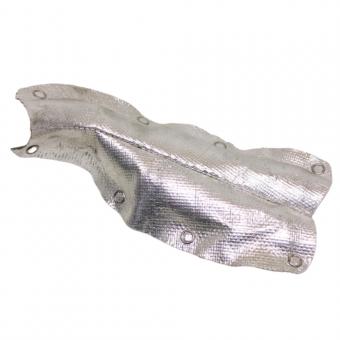
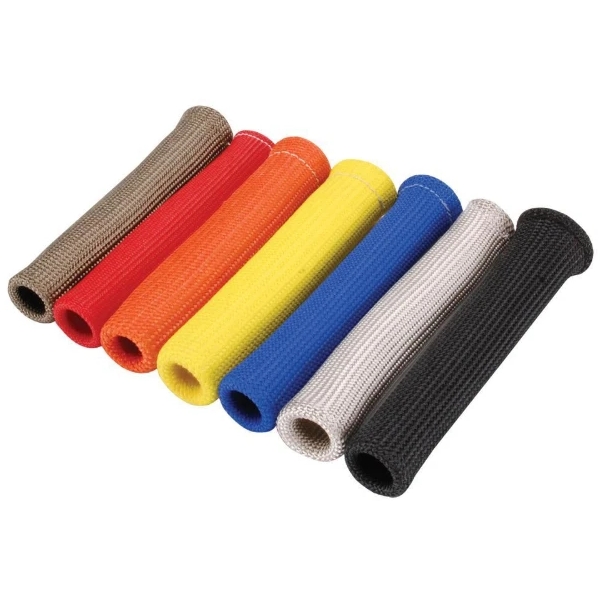
A spark plug boot heat shield is normally a relatively short sleeve that fits over the spark plug boot and the nearby section of ignition wire.
Its primary purpose is localized protection at the point where the boot is closest to a header or exhaust manifold.
BSTFLEX supplies different constructions for this application, including the Spark Plug Boot Heat Shield Protector and the LAVA Volcanic Spark Plug Boot Heat Shield.
These products use flexible high-temperature textile constructions that can slip over the plug boot instead of requiring a rigid fabricated shield around each spark plug.
A boot-style heat protector is usually the logical choice when:
This makes boot shields particularly useful in engines where the exhaust geometry creates a concentrated thermal problem at individual cylinders.
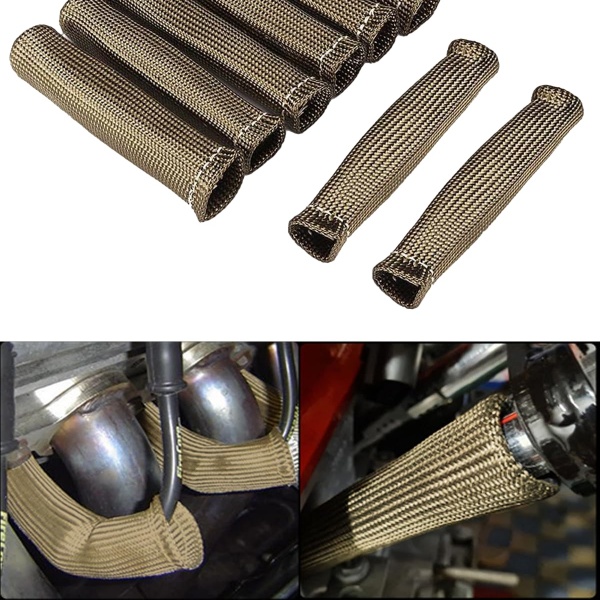
A spark plug wire heat sleeve protects a longer section of ignition wire rather than concentrating only on the plug boot.
The BSTFLEX Spark Plug Wire Thermal Sleeve uses a woven fiberglass construction with a heat-resistant silicone outer layer. It is intended for wires exposed to elevated temperatures around headers and other engine-bay heat sources.
A longer sleeve becomes useful when the thermal exposure continues beyond the spark plug connection.
For example, a plug wire may leave the boot with acceptable clearance but then run parallel to a header tube for several inches. Protecting only the boot would leave the remaining wire exposed.
A longer spark plug wire sleeve is worth considering when:
| Selection Point | Spark Plug Boot Heat Shield | Spark Plug Wire Heat Sleeve |
|---|---|---|
| Main protection area | Spark plug boot and nearby wire | Longer section of ignition wire |
| Typical length | Short localized protector | Cut or supplied to cover extended routing |
| Primary use | Hot spot near plug and header | Extended wire exposure |
| Installation | Slides over individual boot | Installed over wire length |
| Best for | Localized header clearance problem | Longer engine-bay heat exposure |
| Common search term | Spark plug boot protector | Spark plug wire heat sleeve |
The distinction is useful because buying a higher-temperature material does not automatically solve the wrong type of exposure. Coverage is just as important as material selection.
Some installations require both forms of protection.
Consider an engine where the spark plug boot sits close to the header and the ignition lead then continues along the exhaust side of the cylinder head. The first several inches may experience elevated thermal exposure.
In this case, the thermal management system may use a boot protector around the spark plug connection together with a longer wire sleeve along the exposed routing.
This approach is different from automatically adding multiple layers everywhere. The protection should follow the actual heat path.
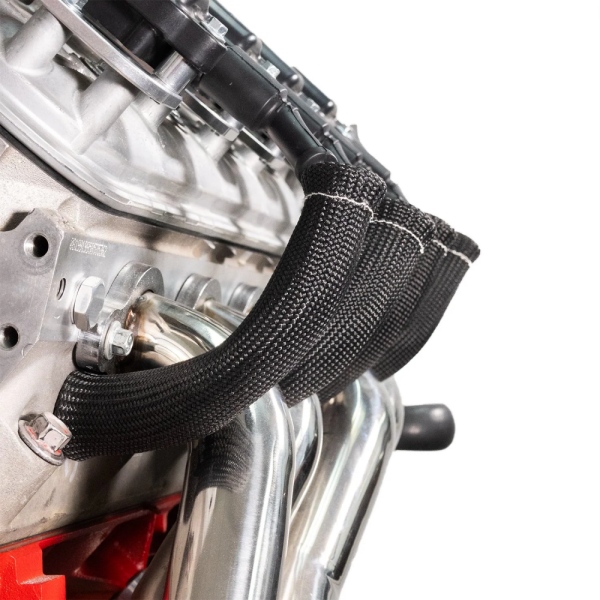
Not every ignition-wire application requires a thick textile sleeve. Where radiant heat is the dominant concern, an aluminized reflective construction may be useful.
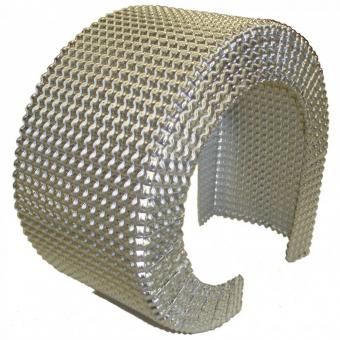
The BSTFLEX Aluminium Plug Wire Sheath combines a fiberglass base with a heat-reflective aluminized surface.
Its function differs somewhat from a conventional colored or silicone-coated wire sleeve. The metallic outer surface is designed primarily to reflect radiant heat from nearby exhaust components.
This construction can be considered when:
This distinction is important when choosing any automotive heat shield.
Radiant heat can transfer from a hot header or manifold across an air gap. The wire does not need to touch the exhaust to become hot.
Contact heat occurs when the protective product or component physically touches a hot surface.
Products designed primarily as reflective barriers are generally most effective when their reflective surface faces the heat source and an air gap remains available.
Flexible high-temperature textile boot protectors may be better suited to extremely tight installations where maintaining a large air gap is difficult.
The correct construction therefore depends on the actual engine geometry rather than only the maximum advertised material temperature.
Before selecting a sleeve, inspect the routing at every cylinder.
Do not assume that all cylinders have the same clearance. On many engines, one or two plug wires may pass significantly closer to a header tube than the others.
Record:
This information helps determine whether the application needs a boot protector, a longer wire sleeve or both.
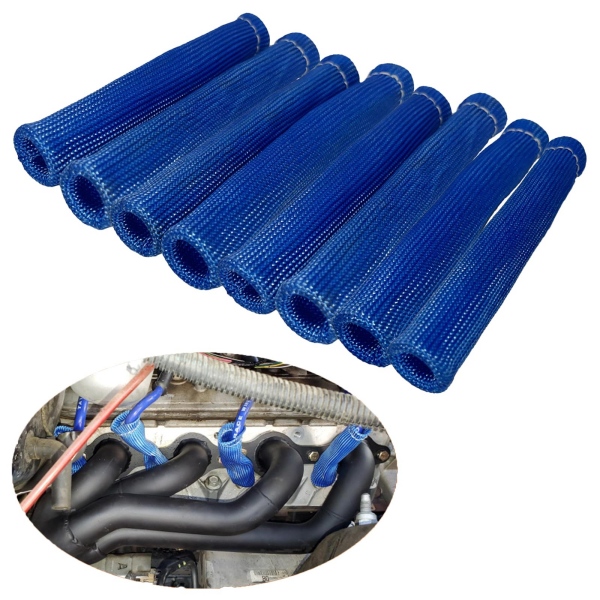
Spark plug boots are available in different configurations. Depending on the ignition system and engine layout, the boot may be straight, angled or formed for a particular cylinder-head geometry.
A flexible spark plug boot heat shield is useful because it can accommodate more variation than a rigid component, but fit should still be checked.
The shield should cover the required hot zone without:
Temperature specifications are useful, but they should not be the only selection criterion.
A sleeve can have an impressive material temperature capability and still perform poorly if it:
For this reason, compare the complete construction rather than selecting a product from a single temperature figure.
Fiberglass is widely used as a base material for high-temperature automotive sleeving because it can be braided or woven into flexible structures that conform around wires, cables and boots.
Different surface treatments then change how the finished sleeve behaves.
For example:
These products should therefore be compared as finished constructions, not simply grouped together because they all contain fiberglass.
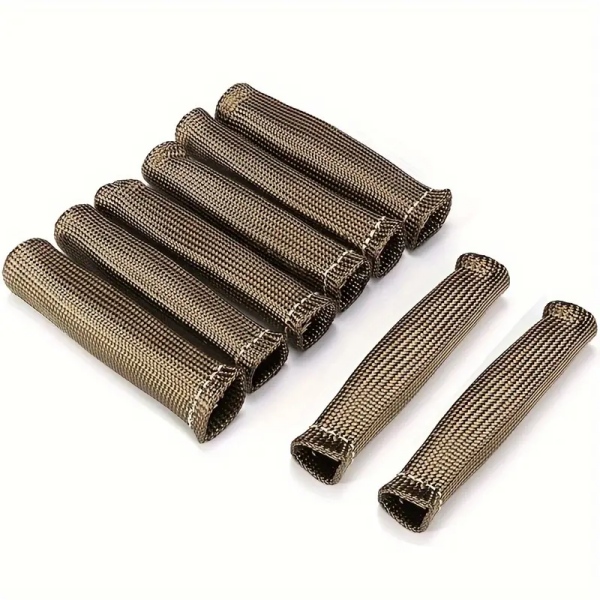
Another option is a volcanic rock fiber construction such as the BSTFLEX volcanic fiber spark plug boot heat shield.
This type of boot protector is aimed at high-temperature engine-bay applications where the spark plug boot sits close to headers or exhaust manifolds.
Its flexible construction makes it suitable for localized protection without requiring fabrication of a metal component around every plug.
When comparing this design with a conventional fiberglass boot protector, buyers should consider the expected thermal exposure, required flexibility, appearance, package size and production requirements.
Aftermarket headers may change the available clearance around the plug wires. A routing path that worked with the original exhaust manifold may no longer provide sufficient distance.
Engine conversions often place the exhaust, steering components and ignition wiring into a much tighter packaging envelope than the original vehicle layout.
A plug wire that rests against or runs unnecessarily close to a header can experience much greater heat exposure than one routed with suitable clearance.
Wire separators, clips and retainers help maintain the intended routing. Missing hardware may allow the wire to move toward a hot surface.
Turbocharged engines, performance vehicles, competition applications and vehicles working under sustained load may produce a more demanding thermal environment.
A heat shield may help reduce the risk of ignition-wire damage caused by excessive external heat. If heat has been degrading the insulation around the wire or boot, improving thermal protection can address that specific cause.
However, a misfire can have many other causes, including:
A spark plug boot protector should therefore be considered a thermal-management component, not a universal repair for every ignition problem.
This depends on the specific material construction and its documented operating limits.
Whenever possible, good component routing and sensible clearance remain valuable. Increasing distance from the heat source reduces the thermal load before insulation is even considered.
If the installation cannot avoid close proximity, the sleeve construction must be selected for the actual exposure condition.
For OEM programs, the RFQ should clearly state whether the expected exposure is:
| Installation Condition | Suggested Starting Point |
|---|---|
| Heat concentrated around spark plug boot | Spark plug boot heat shield |
| Several inches of ignition wire exposed | Spark plug wire heat sleeve |
| Strong radiant heat with some clearance | Aluminized plug wire sheath |
| Very tight header-to-boot clearance | High-temperature flexible boot protector |
| Boot and extended wire both exposed | Combined boot and wire protection |
| OEM or unusual ignition geometry | Custom dimensions based on drawing or sample |
For an OEM, distributor or private-label order, the product name alone is not enough.
A useful RFQ should identify:
Photos and drawings are particularly useful for applications where the boot shape or exhaust geometry is unusual.
Aftermarket customers often purchase spark plug protectors as sets according to engine cylinder count. OEM and distribution programs may require a different approach.
Possible supply formats include:
For production programs, packaging should be specified at the quotation stage so the final unit cost includes the actual supply format.
Protecting the spark plug boot is useful, but sometimes the root problem is a much larger concentration of exhaust heat.
If headers are heating ignition wires, hoses, wiring looms and nearby components at the same time, it may be necessary to evaluate the heat source as well as each protected component.
BSTFLEX groups these localized solutions under its Other Automotive Heat Shield Products range, while other product families address exhaust insulation, reflective sleeves and additional engine-bay thermal barriers.
The correct solution may therefore use component protection, source shielding or a combination of both.
It is a short high-temperature sleeve or protector installed over a spark plug boot to reduce heat exposure from nearby exhaust manifolds, headers or other engine-bay heat sources.
A spark plug wire heat sleeve is a longer thermal-protection sleeve designed to cover part of the ignition wire when heat exposure continues beyond the spark plug boot.
Not necessarily. A boot protector focuses on the spark plug connection area, while a wire sleeve generally covers a longer length. Some installations may require both.
Start by identifying whether the hot zone is limited to the boot or extends along the ignition wire. Then consider clearance, radiant heat, possible contact, required flexibility and the sleeve manufacturer's documented temperature limits.
Yes. An aluminized fiberglass sheath can be useful where radiant heat from the exhaust is the main concern, especially when the reflective surface can face the heat source.
Flexible boot protectors can accommodate many straight and angled boot configurations, but the actual dimensions should still be checked before ordering, particularly for OEM programs.
Custom dimensions, materials, colors, set quantities and packaging can be evaluated according to the application. For non-standard programs, provide drawings, photographs or physical samples together with the expected production quantity.
The best spark plug heat protection is not automatically the product with the thickest wall or the highest published temperature rating.
The correct solution depends on where the heat is coming from and how much of the ignition system is exposed.
For concentrated heat around the spark plug connection, consider a spark plug boot heat shield protector or volcanic fiber spark plug boot heat shield.
When a longer section of ignition wire runs through the hot zone, a spark plug wire thermal sleeve provides extended coverage.
Where radiant heat is the primary concern, an aluminized plug wire sheath provides another construction option.
For OEM, distributor or private-label requirements, send the boot dimensions, ignition-wire diameter, exhaust clearance, photographs, required quantity and packaging requirements so the thermal-protection construction can be matched to the actual installation.

No.10, Chuangxin North Road, Nanshan Park, Ningguo Economic and Technological Development Zone, Ningguo City, Anhui Province, China
tel/Whatsapp : 0086-15856303740
email : sales@bstbraidedsleeve.com
Skype : vanesa-cheng