čo hľadáš?
A battery group number is a useful starting point, but it does not describe everything a heat shield must fit around. The installed battery may have a hold-down across its sides, a cable exiting over one corner, or very little space between its case and a hot component. Before ordering a car battery heat shield wrap, measure both the battery and the route the material will take.
This guide applies to flexible wraps around a conventional vehicle battery case. It helps you prepare dimensions for a Battery Wrap Acid Absorbing Heat Barrier or a LAVA Battery Heat Shield Wrap. Final material choice, coverage and attachment should be checked against the actual installation.
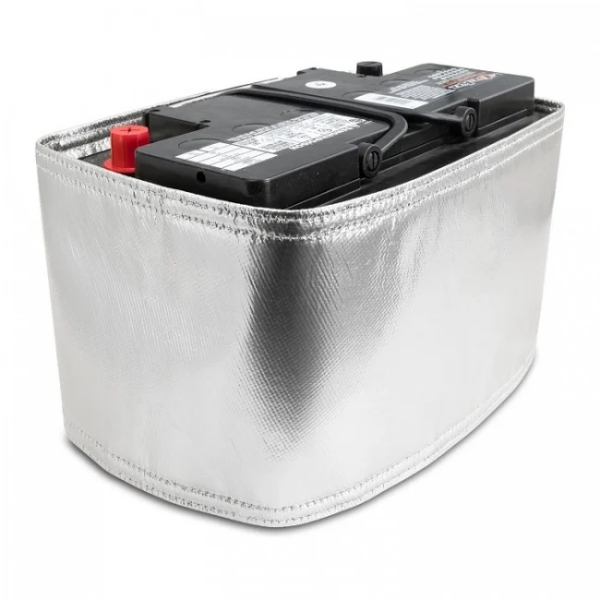
Write down the battery model, chemistry and group size if available. Measure the actual case length (L), width (W) and height (H) in millimeters or inches, and state exactly what each dimension includes. For a side wrap, measure the sidewall height separately from the total height to the top of the terminals. A terminal or handle may be outside the wrap path yet still limit the space available to install or remove it.
Take one photo from above and one from the side facing the nearby heat source. Mark the terminals, vent openings, caps, sensors, cables, tray lip, hold-down, brackets and any existing cover. Measure the narrowest gap to adjacent parts with the battery secured in its normal position. Record where the hot source sits and whether it faces one side, a corner or several sides.
Decide which sides need coverage before specifying the cut length. A wrap for one exposed face has a different path from a wrap around all four sides. For a simple rectangular case, 2 × (L + W) estimates the four-side case perimeter. This is only a starting dimension: follow the intended material route with a flexible tape, including the actual corners and any part the wrap must pass around.
For example, a case measuring 260 mm long and 175 mm wide has a nominal four-side perimeter of 870 mm. That figure is before seam overlap, fastening, edge finishing or changes caused by case shape and existing hardware. Do not use it as the final cut length. State where the seam should sit and ask the supplier to confirm the allowance for the selected closure and material construction.
For a partial shield, identify the covered face or faces on a sketch and measure the path from its starting point to its finishing point. If the shield is mounted away from the case, measure that installed path rather than adding an assumed air-gap allowance to the battery dimensions.
Measure from the bottom edge you want protected to the top edge you can safely cover. Leave the terminals, required vents, service caps and manufacturer-required labels or inspection points accessible. Show cable exits and hold-down contact points on the drawing. If material must be notched or shaped around hardware, provide the position and size of each opening rather than asking for a generic rectangle.
The BSTFLEX battery wrap listing shows an 8 in × 40 in size for part 801000. Treat that as a listed part dimension, not a universal fitment claim. Confirm the direction of those dimensions, the usable installed coverage and any required custom size before ordering. A flat material size alone cannot establish that the wrap will clear your terminals and tray.
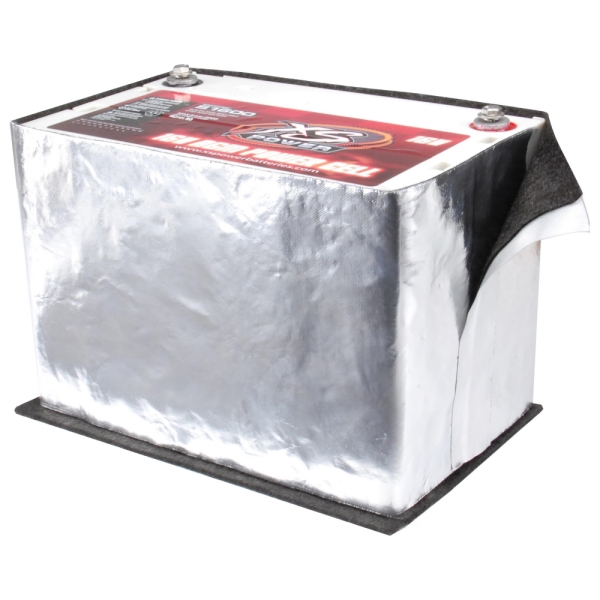
Record the closest distance from the proposed shield to the exhaust, manifold, hot duct or other heat source. Also check the gap to the tray, bodywork and moving or vibrating parts along the entire route. An installation that depends on an air space must retain that space after fastening and during service; there is no single clearance number that fits every material and layout.
Choose a seam and attachment location that can be reached for installation and inspection. Verify that the wrap cannot slip into a terminal, cable, belt or hot surface, and that the hold-down can still secure the battery as intended. Follow the battery and vehicle makers' instructions for electrical isolation, venting and service access. If the compartment is too tight for a stable wrap, revise the layout or consider a different shield construction.
The two BSTFLEX wrap pages represent different material and purchasing requirements. The acid-absorbing heat barrier wrap is the relevant inquiry route when electrolyte exposure is part of the application. Specify the actual liquid and exposure conditions, and request the evidence needed for any absorption or chemical-resistance requirement. The LAVA battery heat shield wrap is the relevant route when the project calls for its volcanic-rock fiber construction. For either one, provide the expected thermal exposure, space and attachment details so the proposed material can be assessed.
If your drawing requires a shaped enclosure with defined openings rather than a length of wrap, review the Battery Thermal Protective Case. The choice between a wrap and a fitted cover should follow the required coverage and the battery's access and cooling needs.
No. A group size helps identify the battery envelope and terminal arrangement, but the wrap also has to fit the installed case, retention hardware and available route. Supply actual measurements and installation photos for a custom quotation.
Measure the case itself where it is safe and practical, then measure the installed clearances with the battery correctly secured. Both sets of measurements matter: the bench measurements define the case, while the vehicle measurements reveal obstructions and heat-source spacing.
Not necessarily. Required overlap, seam construction, corners, material thickness, coverage height and hardware can change the usable fit. Confirm the final cut and installed dimensions against a drawing or sample.
Ready to size a wrap? Send BSTFLEX your measurements, sketch and photos for a quotation. If you are still deciding which construction to use, browse the battery heat shield guide.
značky :

No.10, Chuangxin North Road, Nanshan Park, Ningguo Economic and Technological Development Zone, Ningguo City, Anhui Province, China
tel/Whatsapp : 0086-15856303740
email : sales@bstbraidedsleeve.com
Skype : vanesa-cheng